PORTFOLIO & EDITIONS
All my prints are produced in limited editions, each one signed and numbered.
When an edition has not yet been finalised, I display an artist’s proof — a signed impression made in addition to the numbered edition, usually to test the print’s appearance on paper.
Editioned prints are available for purchase. Please refer to each individual listing for current availability. To place an order, feel free to email me via the contact page.
HOULGATE (NORMANDY, FRANCE)
Houlgate is a gem on the Côte Fleurie in Normandy. For me, it is a true blast from the past — both historically and personally. Historically, it was one of France’s first seaside resorts, and its beautiful villas still bear witness to the Belle Époque, the golden age of the early 20th century before the First World War. Personally, it remains the cherished place where I spent many peaceful summers with family.
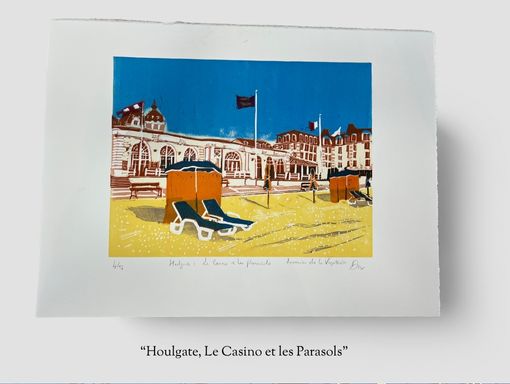
Reduction linocut
Limited edition of 12 on Somerset paper (250 gsm)
38 x 28cm | Printed surface 25.2 x 19 cm
Pictures the iconic orange and dark blue tents on the beach front and promenade on the coastal town of Houlgate in Normandy.
Jackson's Art Prize | Selected for the Extended Longlist 2026
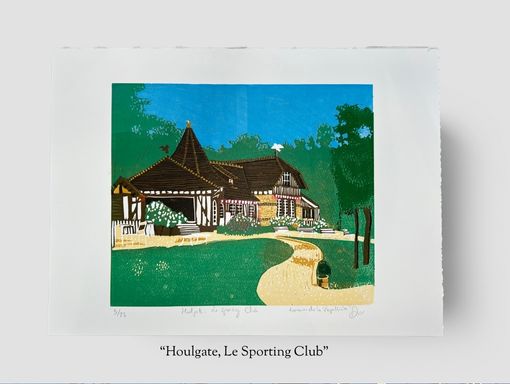
Reduction linocut
Limited edition of 13 on Somerset paper (250 gsm)
38 x 28 cm | Printed surface 25.5 x 21.6 cm
One of the architectural gems of this Normandy coastal town: The chalet of the Sporting, a tennis club founded in 1906 and symbol of Belle Époque seaside elegance.
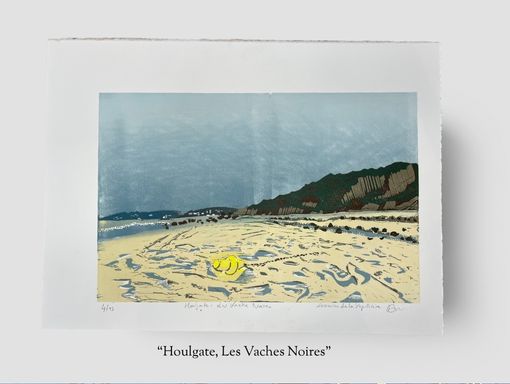
Reduction linocut
Limited edition of 13 on Somerset paper (250 gsm)
38 x 28 cm | Printed surface 30.6 x 20 cm
The striking Vaches Noires cliffs, between the towns of Houlgate and Villers-sur-Mer in Normandy. Made of clay and limestone, these fossil-rich cliffs are both mysterious and majestic. I chose a grey, heavy sky to match the dark layers of the landscape, and added a yellow buoy in the foreground, like a bold contrasting dot of colour.
I thought about adding this small detail when I was reminded of a famous story: at the 1832 Royal Academy exhibition, artist J. Turner, seeing the bright reds in Constable’s painting beside his own muted seascape, suddenly added a tiny red dot to the centre of his work. He turned it into a buoy and it caught every eye.. Sometimes all it takes is one buoy!
PARIS (FRANCE)
Paris — and especially the Montparnasse neighbourhood — brings me back to my childhood. Most of my Paris-themed prints are inspired by this area, surrounded by artists’ cafés and theatres, and by the streets I wandered endlessly as a child.
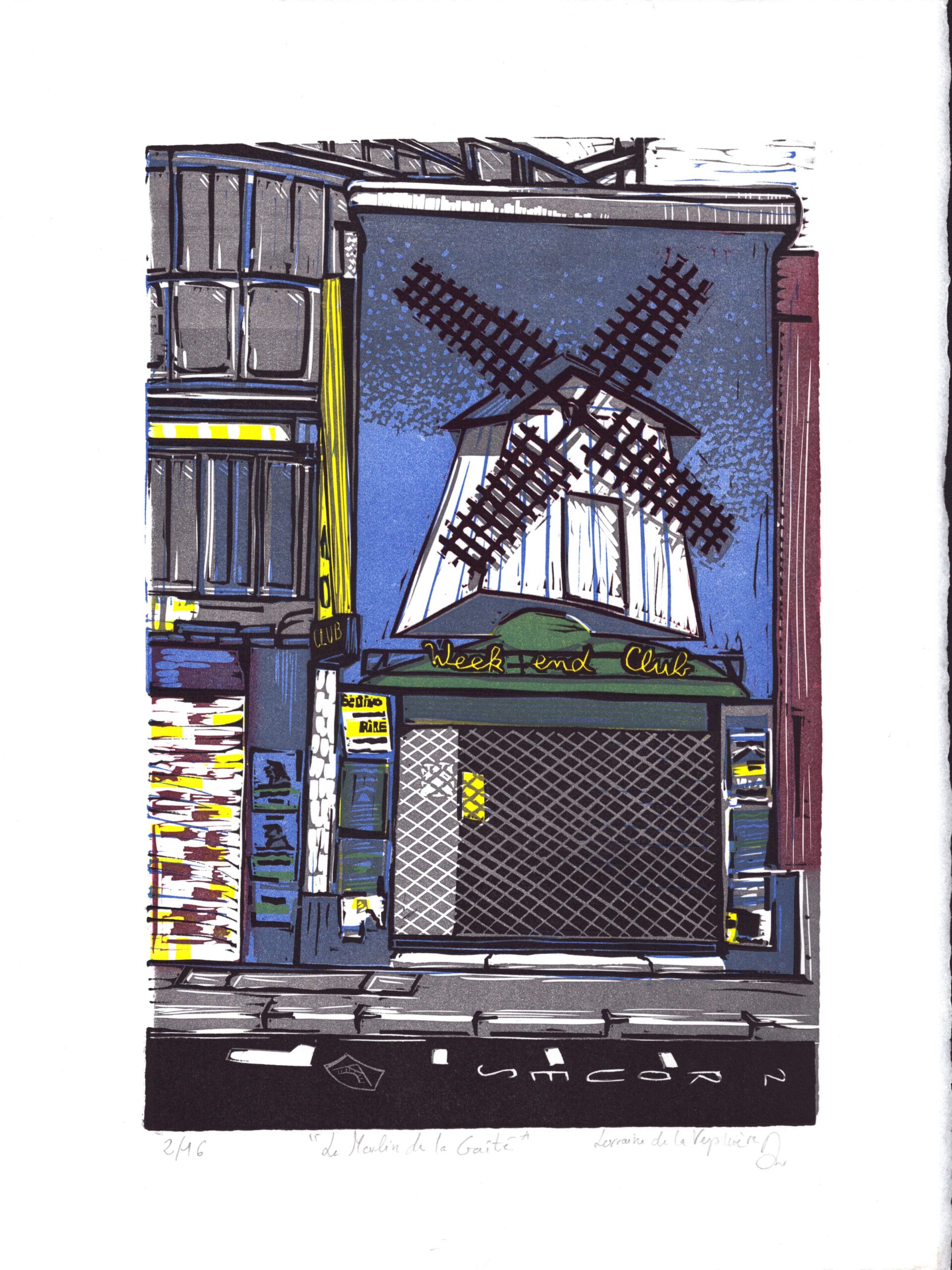
LE MOULIN DE LA GAITÉ
Multi-block coloured linocut
Limited edition of 16 on Somerset paper (300 gsm)
38 x 28.5 cm approx.| Printed surface 29.3 x 20 cm
This print taps into my childhood memories in Montparnasse, Paris and its iconic rue de la Gaîté that I walked back and forth everyday.
I used to love spotting this building with a papier-mâché windmill on it – it used to advertise a bal musette or dance hall with accordion music, le « moulin de la Gaîté », and was still kept when it transformed into a Portuguese night club in the 1980s « The weekend club ». Sadly all was demolished along with the old Bobino theatre next door to make way for a new building.
BICOULOR PRINTING
Printing in black and red ink is one of the earliest forms of colour printmaking. Soon after the invention of the printing press in the 15th century, liturgical texts were often printed in two colours using movable type — a practice that inspired bicolour images as well.
The Arts and Crafts Movement of 19th-century Britain, with its fascination for the medieval and Gothic, revived interest in this striking aesthetic. I enjoy drawing on this visual tradition, particularly in my religiously inspired imagery.
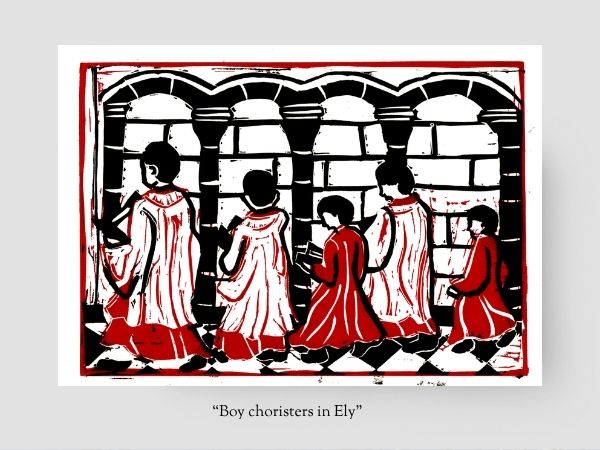
Limited edition of 50 on Somerset satin paper (250 gsm)
14.8 x 21 cm | Printed surface 18.2 x 12.8 cm
MEZZOTINT
My mezzotints explore light emerging from darkness through the subtle gradations of tone this technique allows.
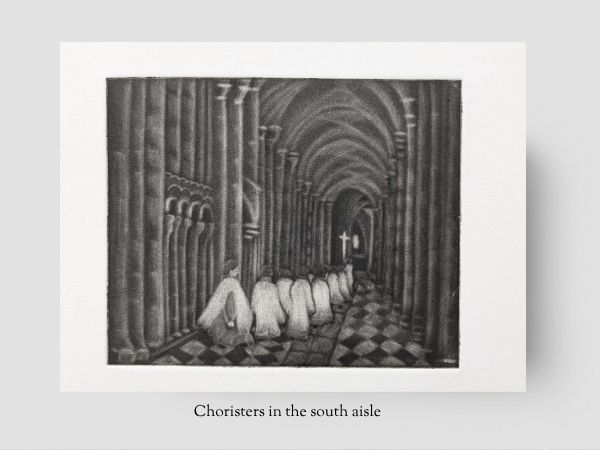
Mezzotint
Artist’s proof on Hahnemühle paper (300 gsm)
Printed surface 15 x 12 cm
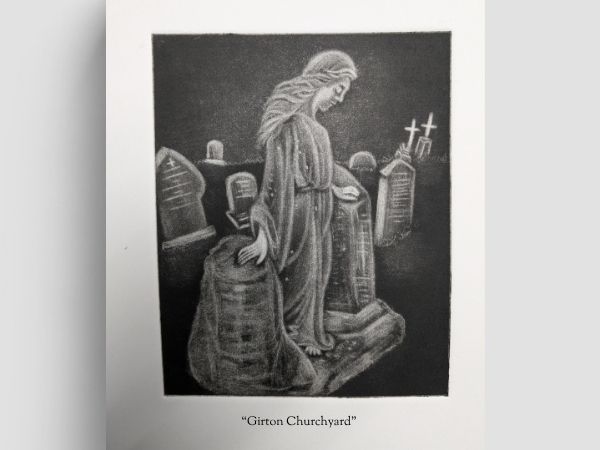
Mezzotint
Girton Churchyard
Artist’s proof on Fabriano paper
Printed surface 15 x 12 cm
This mezzotint was inspired by a tomb located at the entrance of my village churchyard. I have long been drawn to its quiet mystery and beauty, particularly the overarching figure of a grieving woman—or perhaps an angel—whose presence feels both protective and sorrowful.
What fascinated me most was the way one area of the sculpture has resisted time. While the rest of the figure has darkened and become mottled with moss, the hand remains pale and intact, its surface kept smooth and light through repeated human touch. People continue to lay their hands upon it, leaving a subtle record of collective remembrance.
Mezzotint felt like the most appropriate medium to translate this contrast. Through the slow, meditative process of burnishing and rubbing the copper plate, I allowed the hand to emerge from the surrounding darkness – echoing the quiet persistence of touch.
BLACK & WHITE
Although I enjoy experimenting with colour, I am equally drawn to the timeless mood of black-and-white printmaking, perhaps the longest-standing aesthetic in the history of the medium.
In the early modern period, black printing ink was sometimes associated with the ancient notion of “black melancholy” — a temperament believed to heighten imagination and even provoke supernatural visions. I love exploring that deep, introspective quality in my monochrome works.
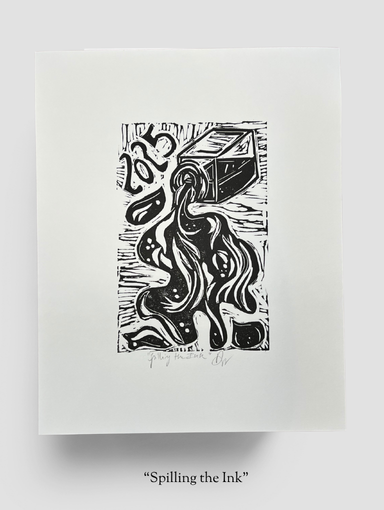
Linocut
Artist’s proof on Strathmore printmaking paper (120 gsm)
20.3 x 25.4 cm | Printed surface 15.3 x 10 cm
2025 New Year design with a spilled inkwell
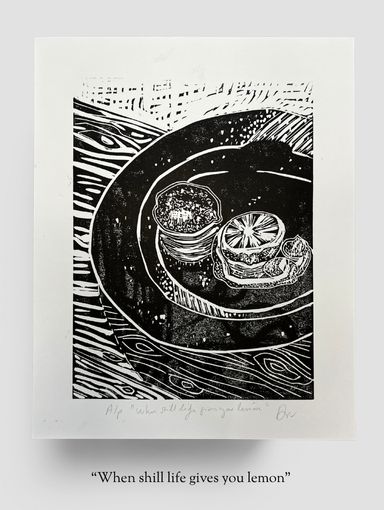
Linocut
Artist’s proof on Strathmore printmaking paper (120 gsm)
20.3 x 25.4 cm | Printed surface 20.3 x 15.2 cm
This work is inspired by two iconic locations in Cambridge: Kettles Yard museum and the Fitzwilliam museum. At Kettle’s Yard, in the home of art collectors Jim Ede, a single lemon is placed on a metal plate – its round shape and its vibrant yellow hue is in harmony with the surrounding art and natural elements.
In contrast, in Jan Davidsz. de Heem’s “Still life with fruit” from the Dutch Golden Age, on display at the Fitzwilliam Museum, the peeled lemon symbolizes mortality, death, and the passage of time. By juxtaposing the whole lemon with the peeled one, my own print explores this interplay between life’s vibrancy and its fleeting nature.
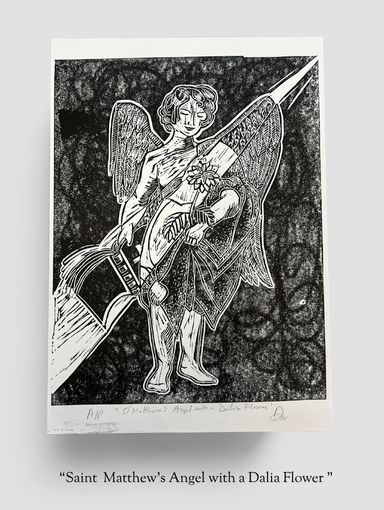
Artist’s proof on Kent printmaker’s paper (190 gsm)
29.7 x 21 cm | Printed surface 26 x 20.4 cm
Private commission featuring the angel, emblem of Saint Matthew, delicately holding a Dalia flower.
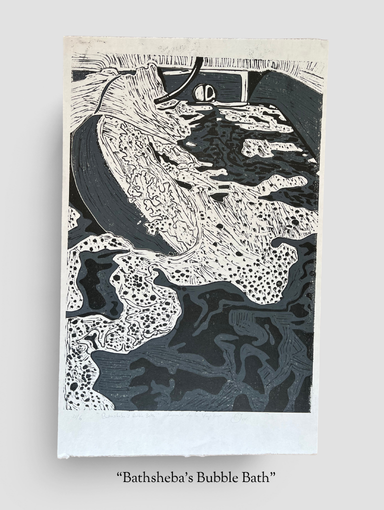
Two-colour reduction linocut
Limited edition of 6, all printed by hand only on Awagami Masa paper (86gsm)
79 x 53 cm approx. | Printed surface 59.5 x 42 cm
This piece taps into a long artistic tradition of depicting women in the bath—a theme rich in art history, from classical paintings to biblical scenes. One of the most iconic is the story of David and Bathsheba from the Bible: King David, from his rooftop, spots Bathsheba bathing and becomes so enamored that it leads to a cascade of dramatic (and morally complex) events.
In this print, I nod to that historic theme—but with a modern twist: think bubbles, a proper bathtub, and the absence of a lurking king… or is there? Perhaps you, the viewer, become the unseen observer in this intimate moment.
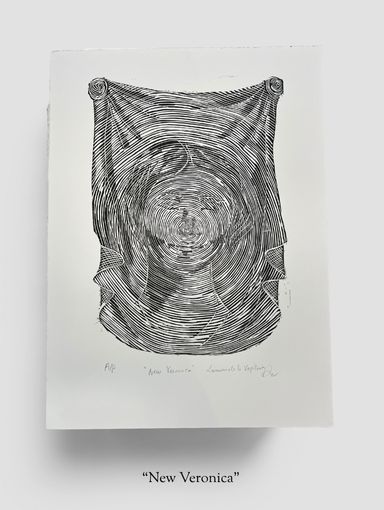
Linocut
Artist’s proof on Somerset satin paper (250 gsm)
38 x 28 cm | Printed surface 30 x 20 cm
This linocut is inspired by the spiralling design of Claude Mellan’s “Head of Christ on St Veronica’s Cloth” (1649) – a single-engraved line forming an entire face, a true tour de force in intaglio! I set out to reimagine it using a completely different technique, relief printing. But my version comes with a twist. Instead of Christ’s figure, the face of a woman emerges. He likeness comes from L’Inconnue de la Seine, an unknown woman who drowned in the Seine in Paris. Her serene expression has inspired countless artists throughout the 20th century. My piece is an homage to this Jane Doe. I gave her a name, Veronica, which in Greek means “true image”. It is also the name of the woman who, in legend, wiped Christ’s face on the way to the cross, the very moment Mellan’s engraving depicts.
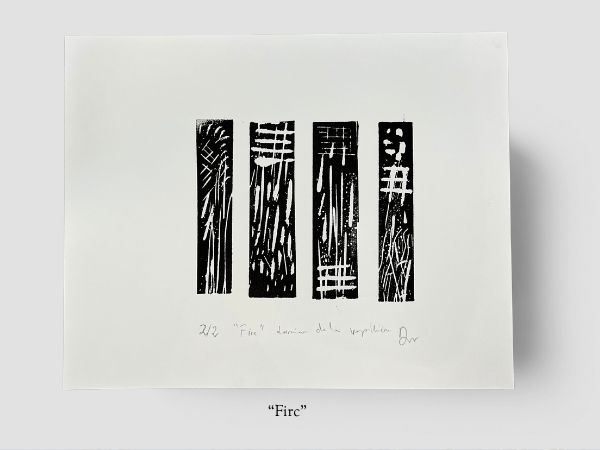
Linocut
Artist’s proof on Strathmore printmaking paper (120 gsm)
25.4 x 20.3 cm
Explosive volcanic eruption or vibrant spectacle of fireworks- or maybe both? I carved four small lino bands, leftover from some of my larger plates. Each resulting print is truly unique: every time I printed, I shifted the plates, creating a one-off effect that makes each piece stand out.
As I worked on these, I couldn’t help but imagine them as stained glass—maybe for a church panel with an apocalyptic twist?
SHOP A PRINT
To shop a print or for special order, please contact me